
Second Skin: Swimwear Beyond the Shore
Swimwear has never just been about swimming. It sits at the intersection of exposure and control, freedom and scrutiny. Unlike most garments, it asks the body to be seen before it asks to be styled. And because of that, it has always carried weight far beyond fabric. What we wear in the water reflects what a culture allows on land. Swimwear evolves with shifting ideas of modesty, gender, power, and performance. It reveals just as much about society as it does about skin. Where surf style speaks to movement, swimwear speaks to visibility. It is less about the act and more about the quiet confidence.
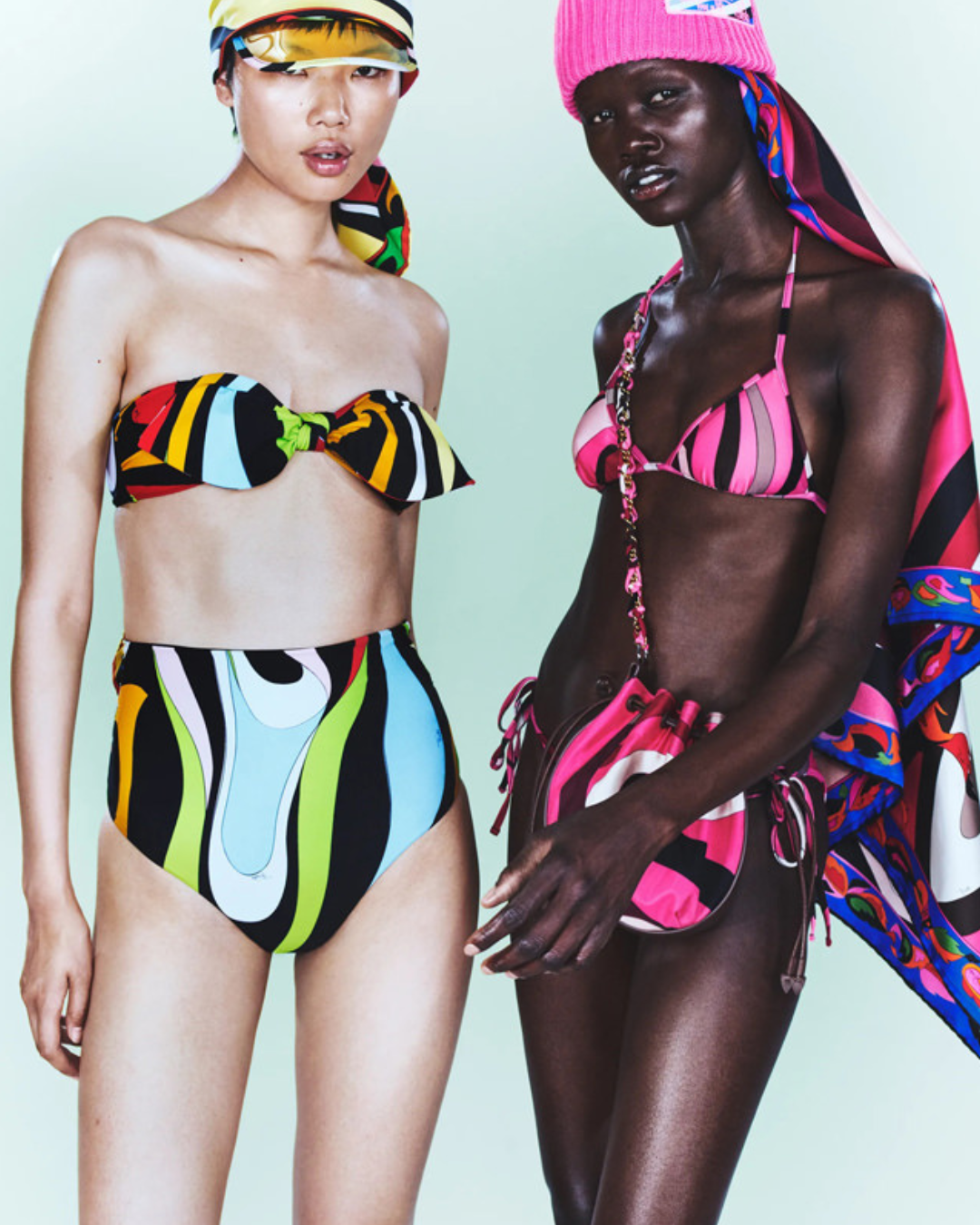
Emilio Pucci Resort 2023 collection. Photo via Emilio Pucci.
The Covered Body
Before swimwear became fashionable, it was restricted. In the 18th and 19th centuries, people entered the water fully clothed. Women wore long bathing gowns, often weighted at the hem to prevent fabric from rising. Modesty wasn’t suggested; it was enforced. The ocean was not a place for display; it was a controlled environment where the body remained hidden.
Even early swimsuits were designed more for propriety than performance. Heavy wool, high necklines, and layered construction made movement difficult. The purpose wasn’t to swim well, it was to be seen appropriately. Water was freedom, but clothing made sure it stayed limited.

Eagle Head, Manchester, Massachusetts (High Tide), 1870. Photo via Winslow Homer.
The Bikini Line
In 1946, everything changed. The introduction of the bikini redefined swimwear entirely. Named after a nuclear testing site, the design was intentionally provocative. It reduced fabric to its minimum and forced a cultural confrontation with the exposed body.
At first, it was rejected. Many countries banned it. It was considered too radical, too revealing, too disruptive. But over time, resistance gave way to normalization. What was once scandal became standard. The bikini didn’t just alter silhouettes, it shifted power. It challenged who gets to decide what is appropriate and who gets to occupy space without apology.

The French Riviera All Year Round, Herve Baille, 1954.
The Body as Statement
By the 1970s and 80s, swimwear became inseparable from identity. Cuts grew higher, silhouettes more daring. The one-piece transformed from conservative to sculptural. Swimwear began to accentuate rather than conceal.
This era also introduced a new kind of visibility. The body was no longer just present; it was styled, posed, and broadcast. Beaches became stages, and swimwear became costume as much as clothing. At the same time, athletic swimwear evolved in parallel. Competitive suits focused on hydrodynamics, compression, and performance. Two worlds emerged: one for movement, one for image.

1970s swimwear. Photo via Click Americana.
Global Interpretation
Swimwear does not exist in one universal form. It adapts to culture, religion, and geography. In some regions, full-coverage swim garments reflect values of modesty while still allowing participation in water culture. In others, minimalism dominates, shaped by climate and social norms.
Tourism has complicated this dynamic. Beaches often become spaces where different standards of dress coexist, sometimes in tension. What is considered normal in one place may be controversial in another. Swimwear becomes a visual map of cultural difference, where bodies carry both personal and collective meaning.

Poolside. Photo via Slim Aarons.
Luxury Interpretation
Luxury swimwear has never been about utility. It doesn’t ask how well something moves in water, but how it moves on the body. Swimwear becomes less about swimming and more about surface, composition, and control. It is design at its most exposed.
Where mass-market swimwear often simplifies, luxury complicates. Fabric is treated as canvas. The body becomes both structure and subject. Every cut, every line, every print is intentional, because there is nowhere for it to hide.

Emilio Pucci La Grotta Azzurra collection. Photo via Emilio Pucci.
On the Runway
When swimwear enters the runway, it loses its original purpose. It is no longer about performance or practicality, it becomes concept.
Designers treat swimwear as a foundation rather than a finished product. A bikini becomes eveningwear when paired with sheer layers or exaggerated tailoring. A one-piece is reconstructed into bodysuits, sculptural forms, or hybrid garments that blur the line between lingerie and ready-to-wear.
Luxury houses have recontextualized swimwear entirely. What was once minimal is now maximal. Hardware replaces simplicity. Cuts become architectural. Fabrics shift from nylon to silk, mesh, and latex. On the runway, swimwear is stripped of its environment and rebuilt as fashion language. It becomes less about water and more about form.

Missoni Spring/Summer 2026. Photo via Coeval.
The Walk Forward
Swimwear has outgrown the shoreline. It moves through industries, geographies, and narratives, adapting to each while maintaining its tension between exposure and control.
To see swimwear today is to see more than design. It is to see how the world chooses to present the body, who gets to be visible, and under what conditions.
And whether on a runway, a screen, or a distant coastline, the question remains the same: Who is swimwear really for?
